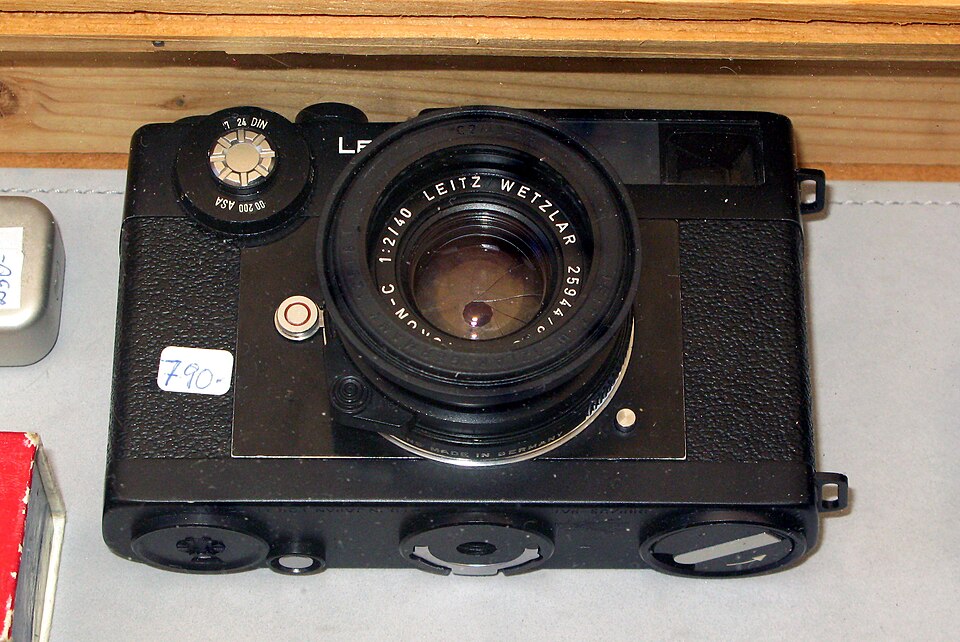
The Leica CL, produced from 1973 to 1976, was a joint venture between Leitz and Minolta: a compact, lighter, and less expensive M-mount camera intended to bring new photographers into the Leica ecosystem. It accepts M-mount lenses (with frameline support for 40mm and 90mm) and has a built-in match-needle TTL meter. The body is noticeably smaller than a standard M.
The CL was sold under both the Leica and Minolta brands (the Minolta CLE, a later variant, added 28mm framelines). It was a reasonable camera and a genuine Leica-mount body, but it sat in an awkward position — too small for photographers who wanted a real M experience, and still too expensive for those who wanted a budget rangefinder. Leica discontinued it after a short run. The CL name was revived in 2017 for a modern APS-C mirrorless body — a different camera entirely.
Key specs
- type
- compact 35mm rangefinder
- mount
- Leica M (limited framelines: 40/90mm)
- metering
- TTL match-needle
- shutter
- cloth focal-plane, 2s–1/500s
- production
- 1973–1976 (co-made with Minolta)
Variants & finishes
The CL was Leica's compact 1970s rangefinder co-developed with Minolta. Chrome is the standard production finish — smaller and lighter than contemporary M bodies, with a built-in meter.

Market value
Used-market price (USD, estimated median)
Estimates from auction and dealer records — condition and completeness vary.
View data
| Date | Price | Source | Condition |
|---|---|---|---|
| 2016-01 | $250 | Dealer Median | Good |
| 2020-01 | $400 | Compact M Trend | Good |
| 2026-01 | $550 | Compact M Trend | Good |
Comments
No comments yet — be the first.