Leica M Monochrom
✦ NotableThe first B&W-only production digital camera. By removing the Bayer color filter, Leica created a sensor that captures luminance with a film-like quality no color camera can replicate in post. It launched a product line and changed how seriously photographers took dedicated monochrome digital.
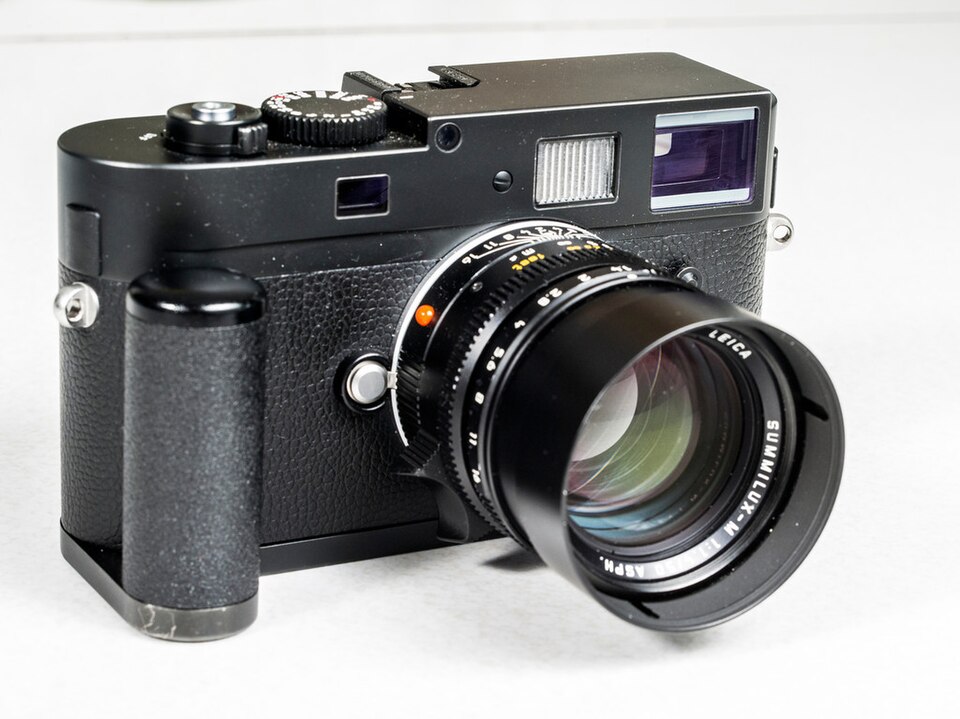
Famous for
- The world's first dedicated black-and-white digital camera — a full-frame sensor with no Bayer color filter array
- Jacob Aue Sobol shot Arrivals and Departures on the Monochrom
- Native ISO 10,000 capability that opened night photography in ways color sensors could not match
In 2012, Leica introduced an idea so simple it seemed obvious in retrospect: remove the Bayer color filter array from the M9's CCD sensor, so every photosite captures only luminance. The result was the Leica M Monochrom — the first production digital camera designed exclusively for black-and-white photography.
Without the color filter array, the sensor gains roughly one stop of effective sensitivity and eliminates the demosaicing interpolation that costs some fine detail. The images are sharper, the grain structure is more film-like, and the tonal rendering has a depth that color-converted RAW files cannot fully replicate. For a photographer committed to B&W, it is a fundamentally different tool. At $7,950, it was a camera for the committed — you could not shoot a color frame with it even if you wanted to. That constraint turned out to be liberating. The M Monochrom established a product line Leica still maintains today (M11 Monochrom, M60 Monochrom), and it demonstrated that there is a meaningful market for cameras that do one thing supremely well rather than everything adequately.
Key specs
- type
- full-frame digital rangefinder (B&W only)
- sensor
- 18MP Kodak CCD, no Bayer filter, 24×36mm
- iso range
- ISO 320–10000
- finder magnification
- 0.68x
- shutter
- cloth focal-plane, 8s–1/4000
- output
- B&W only — no color capture
Variants & finishes
The original M Monochrom — the world's first dedicated monochrome digital rangefinder. No color filter array means every pixel captures luminance; files have a film-like quality unmatched by desaturated color images.
Market value
Launch price: $7,950 (2012)
Used-market price (USD, estimated median)
Estimates from auction and dealer records — condition and completeness vary.
View data
| Date | Price | Source | Condition |
|---|---|---|---|
| 2016-01 | $3,800 | curated-estimate | user |
| 2017-01 | $3,500 | curated-estimate | user |
| 2018-01 | $3,200 | curated-estimate | user |
| 2019-01 | $3,000 | curated-estimate | user |
| 2020-01 | $2,900 | curated-estimate | user |
| 2021-01 | $3,100 | curated-estimate | user |
| 2022-01 | $3,500 | curated-estimate | user |
| 2023-01 | $4,000 | curated-estimate | user |
| 2024-01 | $4,300 | curated-estimate | user |
| 2025-01 | $4,500 | curated-estimate | user |
| 2026-01 | $4,600 | curated-estimate | user |
Comments
No comments yet — be the first.