Leica M7
✦ NotableThe M7 broke a 48-year tradition of purely mechanical M shutters and brought aperture-priority AE to the rangefinder line — the last major M film body before digital took over.
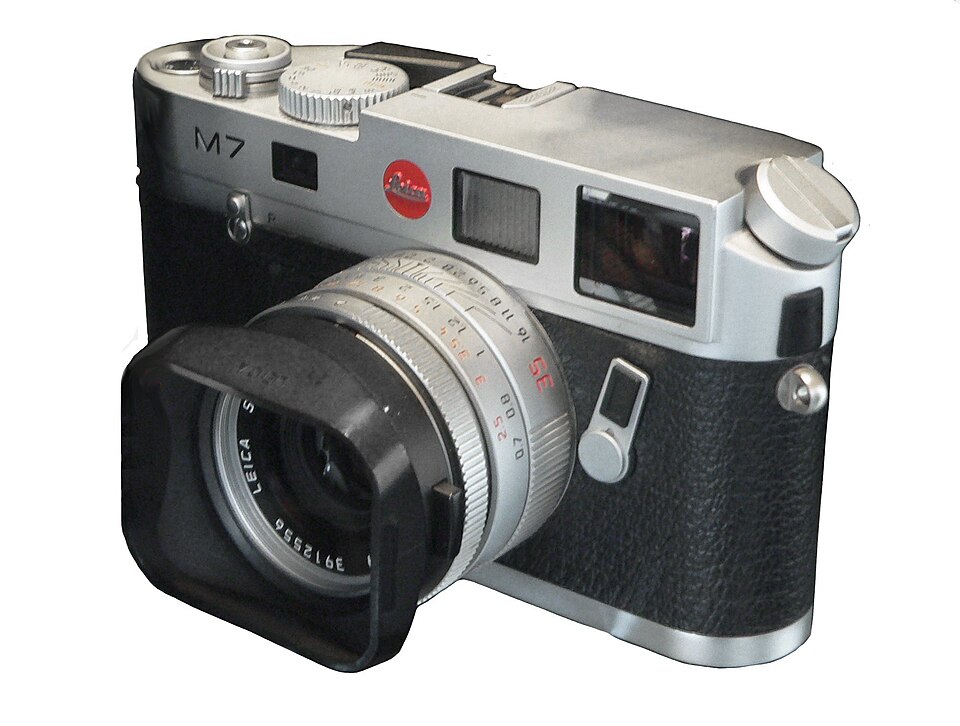
The M7 arrived in 2002 after a decade of requests from working photographers who wanted the M chassis to handle exposure automatically. Leica's answer was deliberate: add aperture-priority AE and an electronically timed shutter, keep everything else. The result was the first M body you could hand to a photojournalist who needed one less thing to think about — and who still wanted the M's silence and size.
For newcomers: aperture-priority means you set the f-stop and the camera chooses the shutter speed. On all earlier M bodies except the M5 you had to set both, every time. The M7 made the M accessible to a generation raised on SLRs.
The trade-off was battery dependency. Unlike a mechanical M, the M7 can only use 1/60 and 1/125 if the batteries die. Purists objected; working photographers didn't care. Leica discontinued the M7 in 2018 when the digital M10 rendered the film M lineup redundant.
Key specs
- shutter
- electronically controlled, 32s–1/1000s
- exposure
- aperture-priority AE + manual
- meter
- TTL centre-weighted
- film
- 35mm, DX-coded
- mount
- Leica M
Variants & finishes
The standard M7 viewfinder magnification — 0.72x suits a wide range of lenses from 28mm to 135mm. The M7 added automatic exposure (aperture-priority AE) to the M6 TTL platform, making it the most capable film M for casual and travel shooting.
Silver M7 with standard 0.72x finder — same AE capability as the black version in the traditional chrome finish.
High-magnification 0.85x finder version of the M7 — favored by 50mm and 90mm shooters for a larger, brighter view. Framelines start at 35mm; wide-angle shooters use an external finder instead.
Market value
Used-market price (USD, estimated median)
Estimates from auction and dealer records — condition and completeness vary.
View data
| Date | Price | Source | Condition |
|---|---|---|---|
| 2016-01 | $1,800 | curated-estimate | user |
| 2017-01 | $1,900 | curated-estimate | user |
| 2018-01 | $2,000 | curated-estimate | user |
| 2019-01 | $2,100 | curated-estimate | user |
| 2020-01 | $2,200 | curated-estimate | user |
| 2021-01 | $2,500 | curated-estimate | user |
| 2022-01 | $2,900 | curated-estimate | user |
| 2023-01 | $3,200 | curated-estimate | user |
| 2024-01 | $3,400 | curated-estimate | user |
| 2025-01 | $3,500 | curated-estimate | user |
| 2026-01 | $3,600 | curated-estimate | user |
Comments
No comments yet — be the first.