Leica M3
Iconic CameraKnown as "The M3"
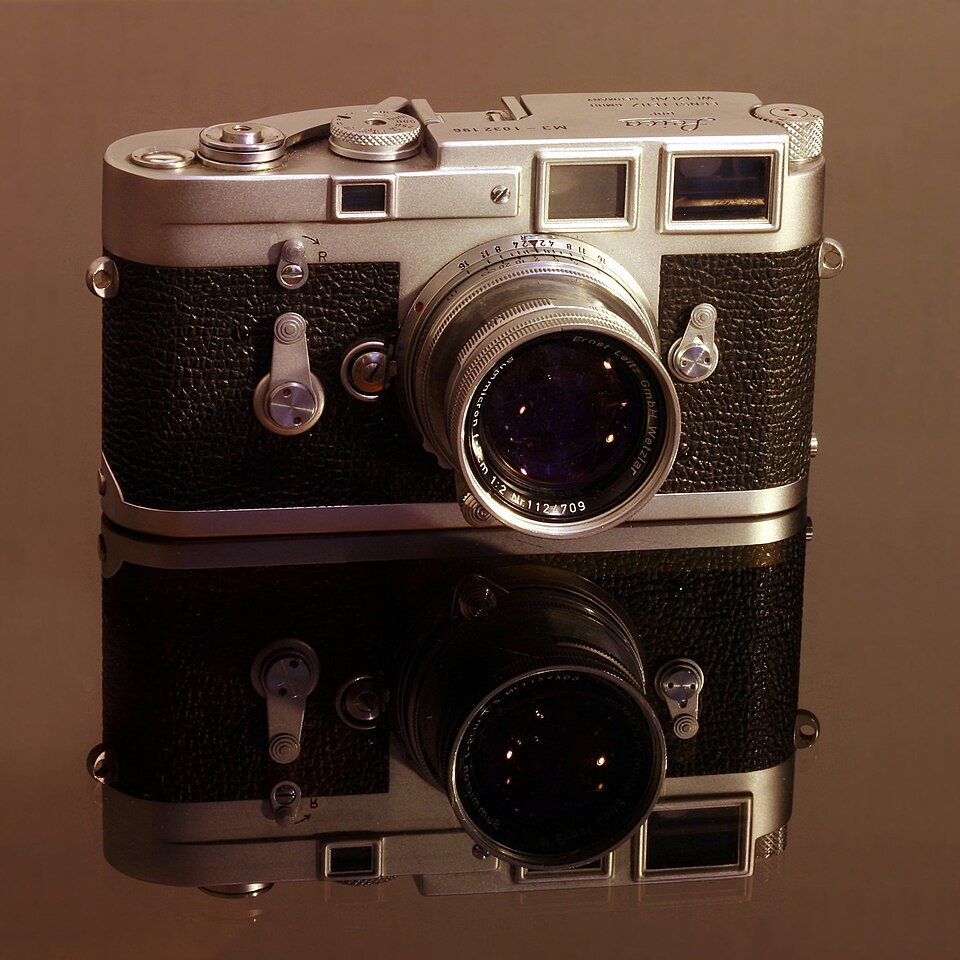
Widely regarded as the greatest rangefinder ever built; debuted the M mount and the finest viewfinder Leica ever made. The benchmark every M since has been measured against.
Famous for
- Henri Cartier-Bresson's camera of choice through much of his career
- Preferred by Vietnam-era photojournalists including Philip Jones Griffiths
- The M-mount's debut: the bayonet that replaced 28 years of screw mounts
When Leitz unveiled the M3 at Photokina 1954, it obsoleted every rangefinder on the market overnight — including Leica's own screw-mount bodies. It introduced the M bayonet mount (still used on the M11 seventy years later), a bright combined viewfinder/rangefinder with automatic parallax-corrected framelines, and a 0.91x magnification finder that has never been bettered in an M body since.
For newcomers: when people say "no digital M finder is as good as the M3's," this is the camera they mean. Over 220,000 were made, so clean users are still affordable — it's many collectors' first classic Leica. Early "double stroke" (DS) bodies need two advance strokes per frame; later "single stroke" (SS) bodies are the more usable pick. Buttondown early examples with Buddha-ear strap lugs command collector premiums.
Key specs
- type
- 35mm rangefinder
- finder magnification
- 0.91x
- framelines
- 50/90/135mm
- shutter
- cloth focal-plane, 1s–1/1000
- production
- ≈226,000 units (1954–1967)
Variants & finishes
Early M3 bodies need two short advance strokes per frame rather than one — a mechanical safeguard Leica removed in 1957. Collectors prize early double-stroke serials; everyday shooters usually prefer single stroke.
Revised film advance completes winding in a single smooth stroke. More ergonomic for rapid shooting and far more common on the used market.
Leica M3 Buyer Guide
Collector & User Inspection Guide
Rangefinder Prism Separation (Balsam Degumming)
Look through the front of the viewfinder from the objective side: look for golden flakes, rainbows, or dark edges in the prism block indicating optical cement failure. A completely blacked-out rangefinder patch requires expensive prism re-cementing.
Double Stroke vs Single Stroke & Glass Pressure Plate
Serials below 919251 are Double Stroke (DS) requiring two wind strokes per frame. Very early DS models (below ~785000) have glass pressure plates. Single Stroke (SS) models above 919251 feature modern steel pressure plates and convenient one-flick advancing.
Original L-Seal (Plombe)
Collectors look for the tiny black wax/plastic "L" seal at the 12 o'clock screw on the lens mount, proving the body was never opened outside the Wetzlar factory.
Photographs made with this equipment3

1962 · Diane Arbus
Child with Toy Hand Grenade in Central Park
Diane Arbus's disturbing psychological portrait of suburban childhood — Colin Wood clutching a toy grenade.

1963 · René Burri
Che Guevara with Cigar (René Burri)
René Burri's Havana interview portrait — the other iconic Che, made on a Leica M during a two-hour argument.
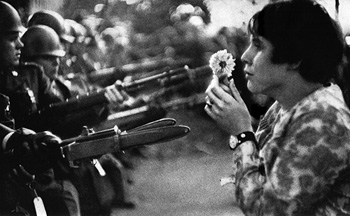
1967 · Marc Riboud
The Ultimate Confrontation (Flower Power)
Marc Riboud's transcendent anti-war icon — 17-year-old Jan Rose Kasmir holding a chrysanthemum against a row of bayonets at the Pentagon.
Market value
Launch price: $447 (1954)
Used-market price (USD, estimated median)
Estimates from auction and dealer records — condition and completeness vary.
View data
| Date | Price | Source | Condition |
|---|---|---|---|
| 2016-01 | $700 | curated-estimate | user |
| 2017-01 | $750 | curated-estimate | user |
| 2018-01 | $800 | curated-estimate | user |
| 2019-01 | $900 | curated-estimate | user |
| 2020-01 | $1,050 | curated-estimate | user |
| 2021-01 | $1,350 | curated-estimate | user |
| 2022-01 | $1,650 | curated-estimate | user |
| 2023-01 | $1,800 | curated-estimate | user |
| 2024-01 | $1,900 | curated-estimate | user |
| 2025-01 | $2,000 | curated-estimate | user |
| 2026-01 | $2,050 | curated-estimate | user |
Comments
No comments yet — be the first.